Showing posts with label bulimia. Show all posts

Sunday, August 2, 2009

Race, eating disorders, and a new controversial book cover

I think most of us reading this blog or other eating disorder blogs agree that eating disorders do not discriminate. They affect different races, cultures, and ethnicities. This is truly not new news. I remember nearly ten years ago, there were studies looking at ethnic/racial proclivities towards eating disorders. I was even featured in a Washington Post article about it (sorry, can only read the first few paragraphs as it is archived). So to me, it seems a bit crazy that people continue to not "get" it.

Recently, there have been articles and studies about the increasing or rather "out of the closet" phenomena that African-American/black men and women are also affected by eating disorders. For a long time, people just thought this group of people were immune to eating disorders. They believed that African-Americans' definition of beauty was
different--that curvaceousness was the more appeasing aesthetic. And that this would somehow protect them from ever developing an eating disorder.

Oh how wrong people can be. In a culture where thinness is prided, there is bound to be a cultural shift. In this 2005
New York Times, it explains how blacks join the eating disorder mainstream. From there, there have been other studies showing the prevalence of eating disorders among this population. Most recently, a study
from USC showed that African-American girls were 50% more likely to develop bulimia than their white counterparts, especially those within the lowest income bracket.

Obviously, this is a problem. It is great that research is looking at this population. However, I think there is still a lack of personal story, biography, memoir for this specific group of people. Many times this can be helpful for sufferers to feel less alone.

This is where Stephanie
Covington Armstrong comes in. Stephanie, a playwright and screenwriter in CA, has written a new memoir,
Not All Black Girls Know How to Eat on her struggle with bulimia. I had not even heard of this book until I read this LA Times Blog asking if this book cover went terribly wrong.

The opinions vary with some feeling it is too graphic, while others feel it it blunt, raw, and to the point. Others say they never would have even guessed the symbolism of the cover had the controversy been stirred. I'm not exactly sure how to feel about the cover. To me, it is on the graphic side, but at the same time, it puts the disorder out there. (or at least one form of bulimia)

I have not read this book, so I cannot say whether it is good, triggering, provocative, etc. But what I am glad about is that there is now a book for this audience. Even though there have
been tons of memoirs on eating disorders, people often want to feel a sense of understanding, and sometimes that happens to be because of race or ethnicity. In the end, my hope is that people do not judge the cover of the book, but rather the contents. After all, that is all what we want eating disordered or not.

Note--*Here is a transcript by NPR about African-Americans and eating disorders.

Tuesday, March 31, 2009

Restorative teeth

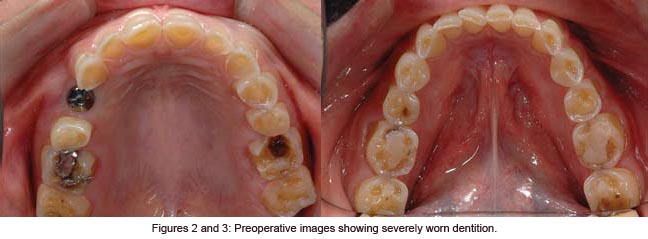
Ever wonder what your teeth could look like from bulimia? Here's an example:

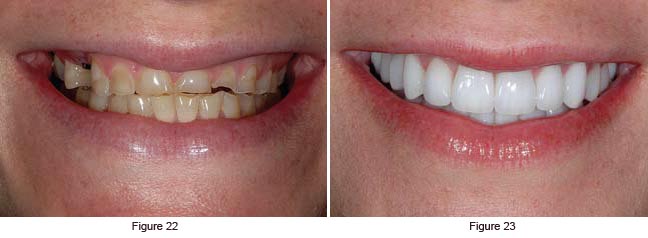
Here's a result after major teeth restoration:

This specific case of a young woman who had recovered from bulimia was featured in the Journal of Cosmetic Dentistry Spring 2008 and is retold here by a Virginia dentist. The press release goes into much detail on the treatment plan and how her teeth were restored.

Besides these interesting details, the conclusion was the best part. This dentist said, "This patient's case involved many of the challenges we face daily in our practice. Just a few years ago, however, I would not have known in which direction to take her treatment. Perhaps I simple would have provided her with a bruxism appliance, while "patching up" some of her fractured restorations and attempting to improve her smile be restoring some of her anterior teeth with direct resins. these would have failed repeatedly, causing us both much frustration."

Though I certainly see this as a wonderful step in cosmetic dentistry, I hope that other dentists will follow in suit. I often wonder how many of us stop smiling or become more self-conscious due to our poor teeth conditions. It's kind of a sad predicament. I hope one day we will all be able to have our smiles back whether it is through cosmetic dentistry or not.

Note--*all images from Full Mouth Rehabilitation and Bite Management of Severely Worn Dentition

*Though the article doesn't talk about it, since this is cosmetic dentistry, the monetary costs for these procedures is quite substantial.

Saturday, March 7, 2009

Handle with Care

Handle With Care

jodipicoult

Currently, I'm reading Jodi Picoult's new novel, Handle with Care. Coincidentally, I was able to actually place the book on "hold" while it was "in processing" at my local library. Thus, I'm the first to get my hands on it before so many other place holds on them. I'm almost halfway through the book, and as is Picoult's style, it is a very engaging read.

From Jodi Picoult's website, a brief synopsis of the book:

When Charlotte and Sean O’Keefe’s daughter, Willow, is born with severe Osteogenesis Imperfecta, they are devastated – she will suffer hundreds of broken bones as she grows, a lifetime of pain. As the family struggles to make ends meet to cover Willow’s medical expenses, Charlotte thinks she has found an answer. If she files a wrongful birth lawsuit against her ob/gyn for not telling her in advance that her child would be born severely disabled, the monetary payouts might ensure a lifetime of care for Willow. But it means that Charlotte has to get up in a court of law and say in public that she would have terminated the pregnancy if she’d known about the disability in advance – words that her husband can’t abide, that Willow will hear, and that Charlotte cannot reconcile. And the ob/gyn she’s suing isn’t just her physician – it’s her best friend.

Besides the story of their child with OI, another story is weaved with their other, adolescent daughter who struggles with not only her sister's illness but also issues of perfectionism, feeling of want by her mother, and simple attention as well. This time, this character turns to bulimia as well as cutting. I thought this was an interesting (though of course realistic too) decision to use the eating disorder as this character's way of coping. In other books, Picoult has used other destructive means like cutting, drugs, etc. But to my knowledge, this was the first she actually used an eating disorder. (I could be wrong on this since I have not read all of her books)

I was able to ask this question to her today in a live Q&A from the Washington Post Book World discussion. Kind of exciting! After her answer, it made more sense to me why she chose this means per se. I think a lot had to do with the fact that eating disorders are so secretive and because her mother was wrapped up taking care of the other daughter with OI, her other daughter's emotions, struggles, lack of coping well, flew under the radar.

I also asked if in the future she was going to use an eating disorder individual as a main plot line. I was holding out hope that maybe she would consider this as I'd be very interested to see how she developed the character. Sadly, she thought she probably would not any time soon. Oh well. However, if you're interested in autism, her next book's main character revolved around this diagnosis as well as being accused of murder.

Anyway, I'll give an opinion of the book once I'm finished if anyone is interested. If you haven't read her novels, I highly recommend them. She does a great job with in-depth characters, weaving different plot lines, discussing many issues revolved around families, and she always has a moral question in her books, often with a twist at the end. Some people find her books a bit predictable, and in a way they are once you know her style. Still, however, they make you think twice about how you would handle a certain situation. And any book that leaves me thinking more is a great read in my opinion.


Wednesday, January 7, 2009

Neurocircuitry in bulimics

New research in an article on the brain differences in bulimics appears in the January issue of the Archives of General Psychiatry. The study consisted of 40 participants (20 with bulimia who had a median duration of illness of nine years and 20 healthy controls). While undergoing functional magnetic resonance imaging, participants were shown pictures with arrows pointing left and right and were asked to identify which direction the arrows were pointing, regardless of where the arrows were on the screen. This is also known as the Simon Spatial Incompatibility Task.

The results showed the bulimics were faster but less accurate on more difficult trials which indicated impulsivity and less self-regulatory control. During correct trials, those with bulimia had less activity in their frontostriatal region than healthy controls. In incorrect responses, bulimics activated the dorsal anterior cingulate cortex more often. This contrasted from the healthy controls who activated the anterior cingulate cortex while responding correctly more and the striatum during incorrect responses.

The importance of researching the frontostriatal region of the brain is because it regulates both serotonin and dopamine. Research has often implicated serotonin and bulimia, but dopamine hasn't been studied as frequently.

The other interesting question this brings up is what Daniel le Grange, author of the new book Help Your Teen Beat an Eating Disorder asks, "
Does the abnormality occur because someone has bulimia nervosa, or does it contribute to developing it?"

This reminds me of the chicken and egg syndrome which invariably can be different for everyone. Depression and eating disorders is often used as an example. Some will say it was the depression that set off their eating disorder, while others say it was vice versa. I don't know if there is one right answer. But what I do think is that the perceptibility to an eating disorder already exists, whether through genetics or neurocircuitry, and perhaps through engaging in more disorderedness, the brain further changes. I could be completely wrong though too and maybe it's just rewiring from the beginning. More research is already underway looking at adolescent brains whose onset of illness is of less duration than those in this particular study.

Monday, December 15, 2008

CBT-E and eating disorders

The hot article of the day is about about a "new" form of Cognitive Behavioral Therapy (CBT) called Cognitive Behavioral Therapy-Enhanced (CBT-E). It's interesting to see how the media decides to title the article. Words range from "potential" to "curing" eating disorders.

CBT-E, developed by Christopher Fairburn, professor and researcher at Oxford University, is an extension of the standard CBT treatment used for bulimia. Fairburn developed two forms of CBT-E--one focuses only on the eating disorder, while the other also delves into low self-esteem and extreme perfectionism issues.

In a study of 154 patients with bulimia and "atypical" eating disorders, results found the majority showed improvement and had sustained effects over a period of a year with both forms of
CBT-E. Two-thirds of those finishing the study had complete and lasting responses.

Fairburn says, "
Now for the first time, we have a single treatment which can be effective at treating the majority of cases without the need for patients to be admitted into hospital." He is now currently studying a large-scale trial using CBT-E with anorexic individuals.

I guess I'm not quite seeing what the big hoopla is and how this
CBT-E is "different" from standard CBT. I'm certainly not a fan of some media outlets saying how this therapy could "cure" eating disorders. Perhaps, that's just the skeptic in me.

I guess my other qualm with all this is, well, shouldn't issues of perfectionism, low self-esteem, depression, etc. already be addressed in whatever therapy is considered?

Obviously, more information on this new psychotherapy needs to be given. Maybe those of you in the UK might know more about this since it is apparently increasingly being used there.

Here's an interesting article
The Independent which asks similar questions and looks at both sides of the coin in how CBT is effective and also its problems.

Monday, November 24, 2008

Bulimia is a dental disease

We all know that eating disorders can wreck havoc on oral health. Bulimia, most notably can take a heavier toll at first symptoms which continue to accumulate further as the eating disorder progresses. In this press release, Dr. Brian McKay, a dentist in Seattle, discusses his new book, Bulimia is a Dental Disease.

McKay's goal is not only to educate about the damage of bulimia to one's oral health, but also to bring together the dental community in helping eating disorder clients. McKay says, "
We need a change in the Standard of Care. Dentists must form alliances with eating disorder professionals. Together we can treat both the mental and oral aspects of this disease and the result should be a higher success rate. There is nothing more inviting than seeing someone smile again."

To my knowledge, this is the first book exclusively addressing bulimia and dental health. I have no clue how the book is, but I think it is a good step to help educate and bridge the gap between dentists and eating disorder clients.

In my opinion, I think even if dentists may know there is a problem, there is a hesitancy in bringing up the issue despite the fact that some clients may come in multiple times or simply for one visit never to be seen again. As much time as I've spent in dentists' offices over the last twelve years, not one brought up or asked about my eating disorder. It kind of felt like the giant elephant in the room. It wasn't until a few years ago when I changed dentists and decided to be completely honest that it was discussed. I found them (there were two at the time) to be non-judgmental and helpful, even when I was so frustrated that the damage was completely irreversible despite reducing my purging behavior.

The take home message is that dentists and professionals need to collaborate together to help their eating disorder clients. In effect, this will allow clients to communicate and discuss these issues, even if it is only about damage control, like Lola posts about here.


Tuesday, November 27, 2007

Tooth misery saga

Now, it's Monday (well technically Tuesday). The pain was a little better today overall. I saw my dentist in the morning. She did an x-ray and looked at the tooth which confirmed the infection yet again. I had a similar infection in this same tooth a little over a year ago. Basically, she said I had to have it extracted. Otherwise, it would just be a continuous cycle of infection, getting better wit antibiotics, infection again, etc. On top of that, the infections would be more frequent. I was so not happy to hear this. This side of my mouth (upper left jaw) already has a bridge there which I'm still paying for. I almost regret getting it now and feel suckered into it even though it was the only option at the time.

My dentist wants me to have his done soon, but my problem is my dental insurance won't kick in for any major work until after the first of a the year. I already have another crown that needs to be done as well. I know my insurance is not going to cover the extraction. One of the dental assistants asked me why I don't get the extraction done now? Well, basically because I was in a huge amount of pain afterwards with no pain medication that worked and it's very expensive. My mom paid my last one, and it's just the whole guilt thing there. She spent a lot of money on me this weekend. It was her choice of course, but still I just feel undeserving of it. She told me it was a part of Christmas, so I hope she sticks by that.

Anyway, I will now have three holes in my mouth when I get that extraction done--one hole from my previous extraction, the second from the new extraction, the third from the missing half of my tooth that needs a crown. This is all in conjunction with also needing to redo my bridge on the right upper side of my mouth. This is when I just think ripping out all my teeth and having dentures is the way to go. I mean it would be a lot less costly then.

I tell my parents this news. Neither are happy of course and feel badly for me. My dad replies with "geez, you're not going to have any teeth left. I'm glad you're over that "problem" (meaning bulimia). I'm just sad you have to go through all this tooth trouble." My mom's reply was, "I knew the eating disorder caused some problems. I wonder why you're having such problems?" Does anyone not see how neither connect the dots or something? My reply to my mom was "well, yes, eating disorders cause damage to teeth. It's individualistic with some not having many teeth problems, while others do. I was unlucky I guess."

In the end, it just sucks how much damage can be produced on your teeth due to an eating disorder. Even without consistent damage, the effects can be devastating and continuous. I'm proof of that.